The many voices of the maker

Professor Nirav Christophe says farewell to HKU

What does the artistic creative process of the artist look like, and what can be taught about it within arts education? With this question, Nirav Christophe launched his first professorship at HKU in 2006, Theatrical Creative Processes. Twenty years later, on 10 June 2026, he concludes his third professorship, Transgressive Artistic Practices, and bids farewell to HKU.

Over the course of two decades, his research evolves across three professorships: from the individual creative process, via the interdisciplinary, and towards a multidisciplinary perspective – more recently relabelled as “transdisciplinary”. In all the work Christophe’s has done on creative processes, “multivocality” has always been a central thread: the many voices within each maker, which contain a wealth of information, provided the artist becomes aware of them.

How to write a good screenplay?

In 1992, Christophe was asked to establish the first Bachelor’s programme in playwriting for theatre writers in the Netherlands at HKU. As trained scholar of Dutch language and theatre science professor, he already had considerable experience in writing radio drama and for theatre and film. He served as study programme leader for almost ten years. During that period, he came to realise that very little research had been conducted into artistic creative processes. “Much of arts pedagogy was essentially what I call ‘product pedagogy’. Everything that was known about learning to write focused on: what does a good screenplay look like? It was never about how one arrives at a good screenplay. Yet it is only by understanding that process that one can teach it properly. That was the core of my first research project. I had a personal need to gain deeper insight into the individual creative process, along with a strong pedagogical drive to teach that to others.”

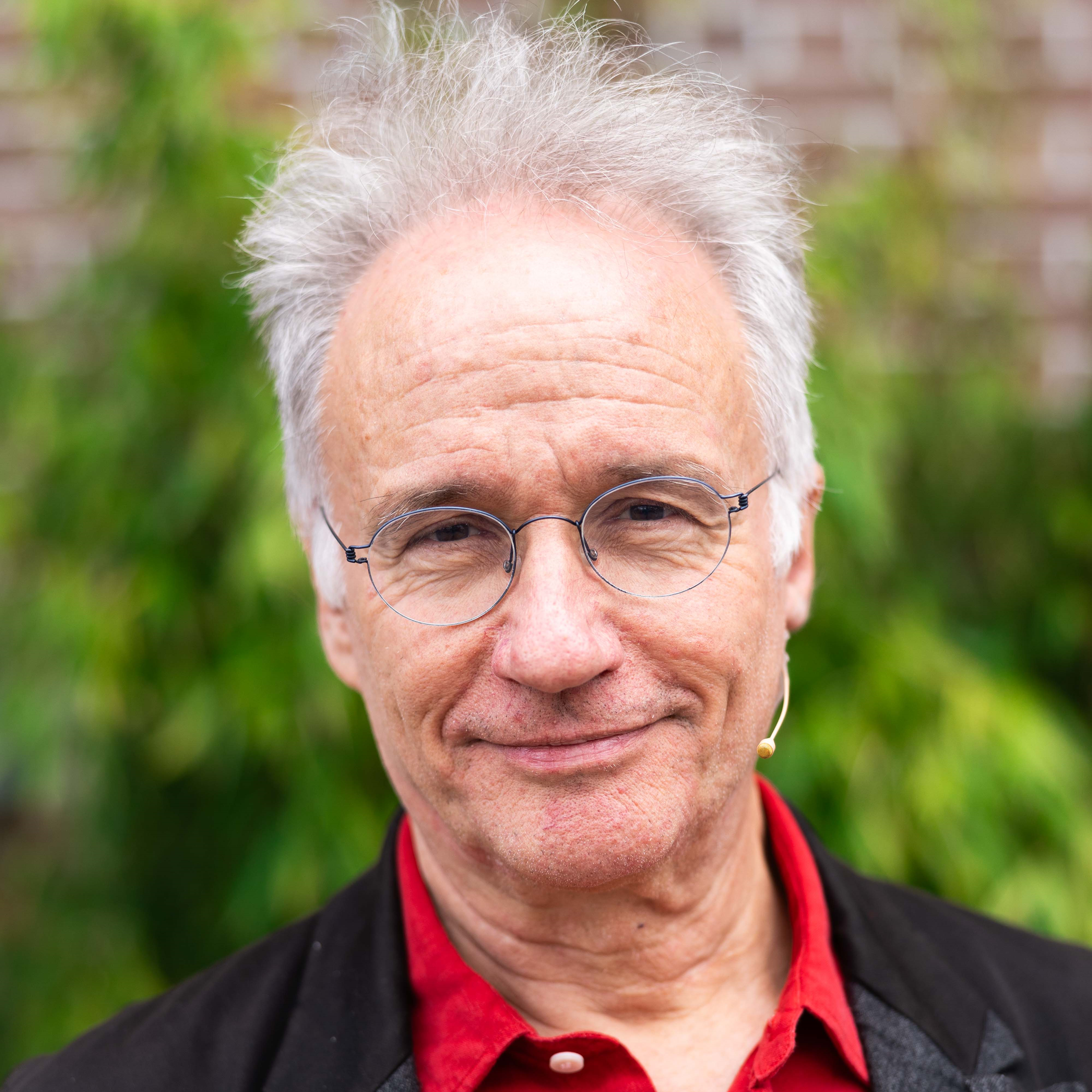
Professor and writing teacher Nirav Christophe departs from HKU after 35 years. Photo: Jesse van den Berg.

Permanent tension

When the opportunity arose in 2006 to apply for a professorship, Christophe established the Theatrical Creative Processes research group. He explored the individual creative processes across all disciplines within theatre, and how these work in tandem. “A writer works differently from an actor, who in turn works differently from a designer or a costume designer. And there was a permanent tension, because they were unaware of their differences. For example, a costume designer who has worked hard on a set of costumes brings them to a rehearsal to be fitted and tested. The actors respond cold or even negatively. They don’t realise that, at that moment, the costume designer is experiencing their premiere!”

The language of the creative process

In the years that followed, Christophe worked on developing a vocabulary that makes the creative process intelligible, both at an individual level and across different disciplines. Initially within theatre, and later also across other performative arts. He describes its various phases: for instance, the moment when more structure needs to be introduced, the moment of a suddenly emerging insight (the illuminative phase), or the moment when one should instead step back or shift to something else (the incubation phase).

In his book Het naakte schrijven (Naked Writing, 2007), he shares his unconventional ideas about the writing process and offers tips and exercises that dismantle the enduring myth of authorship as a ‘God-given’ talent.

Hybrid artists

The professorship Theatrical Creative Processes was succeeded by that of Performative Creative Processes (2014-2022), nwhich still focused on closely interrelated artistic disciplines. Yet Christophe observed in his practice that an increasing number of makers opened up their disciplines and worked across other domains. Playwrights making podcasts, visual artists working with hospital patients. “Do they learn about that with you?” he asked HKU’s programme leaders. The answer was often: no. This became the seed for his third professorship: Expanding Artistic Practices (2022-2026). It was about exploring how makers operate in other contexts, often in social environments and in co-creation with other professionals or individuals with lived experience. The research garnered valuable insights into what is needed in arts education to prepare students for this kind of ‘hybrid artistry’.

“The search for form is the essence of the work”

Across disciplines

Twenty years of research into creative processes: from individual to interdisciplinary, to multidisciplinary, and finally “transdisciplinary”. In broad strokes, this sentence summarises Christophe’s professional development. The latter term, however, remains difficult to define, the professor adds. “Think of it as a personal appeal, in which you as the creator can no longer place yourself outside the work. You cannot say: I am an artist, I have an idea and I will make it. Because you are operating within a context that is just as important as you are. Mind you: not more important! Because you are not entirely subservient to it. Transdisciplinary practice also means not knowing what the outcome will be. The search for the form is the essence of the work.”

Multivocality

Across all his research, the concept of “multivocality” always remained a guiding thread for Christophe: the many voices within each (prospective) maker, which alternately speak in an incessant flow of thought. These conscious and unconscious inner voices can slow down, accelerate, sabotage, or block the creative process. “Think of the inner critic saying: ‘you’re never going to succeed’, or the voice of your father or mother, a teacher, a client, or the voice of your body – which is often far wiser than you. When you get stuck in your creative process, it is usually because one of those inner voices has become dominant. I have found that becoming aware of this multivocality is very helpful for students, but also for teachers and patients with whom we have worked within the professorship. Being able to identify which voices are involved in all of us, welcoming them and accepting them, greatly supports the creative process.” In his book Ten Thousand Idiots (2018) Christophe illustrates what this multivocality can look like within the artistic process.

'Becoming aware: this voice is mine as well'

That art thou

An example of a creative strategy for transdisciplinary co-creation is “That art thou”, a method derived from the Chandogya Upanishad, an important philosophical text within Hinduism. “It means that you learn, and train yourself, to be able to think in everything and in every person: that is also me. So not merely the empathy of ‘I can imagine that’, but the realisation: this voice, this feeling, is also within me. I sometimes use a fragment from the film Human in my classes. In it, students are shown close-ups of people from all over the world for several minutes. And in each gaze, you can think: that is also me. That veiled woman, that frightened boy, that angry old man. You see something human. And that makes you humble, and enables you, as an artist or designer, to let go of your ego when working in transdisciplinary collaboration with, for instance, a patient.”

Awareness of your own voices

Experiencing multivocality is an extremely important instrument for the artist, Christophe argues. Particularly for the hybrid artist operating within society in order to create. “Listening and searching for a shared language in a different environment, and being aware of your own inner voices within that context, helps to smooth the process.”
The never-taught lesson

Nirav concludes his career at HKU with a ‘never-taught lesson’ described in his book Een leeg vel; Laatste lessen in schrijven en schrijfpedagogie (A Blank Page; Final Lessons in Writing and Writing Pedagogy). “Which lesson have I held back, which lesson did I find too stressful to teach? Let me write that down now, I thought. And that lesson is to take a radical look at artistic work as a holistic practice. To show that it is an interplay of body and mind, of reason and emotion, and to learn to connect these. I hope that in pedagogy and research there will be increasing attention for this. That this lesson continues.”

Work by Anton Feddema, made for the cover of the textbook Een leeg vel: laatste lessen in schrijven en schrijfpedagogie.