Across increasingly polarised societies, shaped by migration, social fragmentation, and the pressures of global crises, people struggle to speak with, listen to, and understand one another. The research by Zoya Shojaee Sardashti investigates how participatory performance can open more caring dialogues between individuals: a relational environment where theory, embodied knowledge, and lived experience meet.
The Performativity of Nonviolence in Translation
How can performance-based, autoethnographic practices cultivate relational, nonviolent engagement across cultural and linguistic divides? Zoya Shojaee Sardashti explores embodied, performance-based activities and collective narration practices as part of the PhD trajectory in artistic research in the partnership Meaningful Artistic Research.
The Performativity of Nonviolence in Translation
Communication shifting from argument to attunement
These performances and performative interventions, ranging from one-to-one encounters to collective public rituals, create spaces that are neither strictly “art” nor simply “dialogue.” Instead, they function as shared terrains where lived experience can be voiced, witnessed, and translated, so that communication shifts from argument to attunement. Through autoethnographic writing, voicing one another’s texts, and shared experiments with breath, rhythm, and multilingual expression, participants begin to explore difference not as an obstacle but as a practice of ethical relation. These questions anchor an evolving field of practice that sits between performance, care ethics, conflict transformation, and civic life.
Zoya approaches this field as a performative ecology of nonviolence, a living system that thrives on interdependency, reciprocity, and shared vulnerability. Drawing on Judith Butler’s understanding of nonviolence as an ethical bind rather than a moral position, this research treats nonviolence as a technique that can be cultivated through embodied practice.
Here, nonviolence is not a performance about peace; it is a rehearsal of relational ethics. Participants explore how gestures, pauses, breaths, hesitations, tonal shifts, collective narration, can change the conditions in which dialogue unfolds. Rather than debating values, the work attends to how people inhabit difference together, and how ethical responsiveness is practiced rather than declared.
Home Soil Projects
As founder of Home Soil Projects, Zoya works with participants, artists, students, community members, and practitioners to navigate cultural and social uncertainty, experimenting with forms of translation that prioritise listening, resonance, and relational presence. Over time, these practices shift not only individual understandings, but also the relational field between participants. Home Soil Projects: the body is one’s home, and the relationships we cultivate create common ground between us.
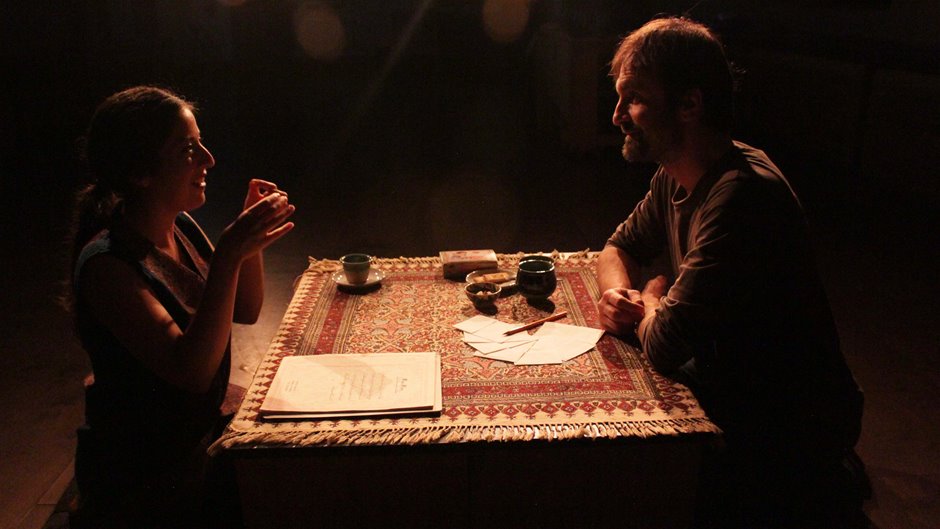
Learning Farsi on 테헤란로 Teheran ro, Mare Culturale Urbano, Milan Italy, 2018. Photo: Heliya Haq. Home Soil Projects.
A practice-as-research inquiry
Zoya’s research draws on over a decade of socially engaged performance across Europe, the United States, and Asia, including one-to-one interventions, sound-based collective narration, and ritual practices addressing matrilineal memory, migration, and recovery. Their doctoral work studies what happens within these encounters: which tensions arise, what forms of knowledge surface, and how embodied practices shape ethical responsiveness in real time.
Rather than situating performance as protest or disruption, this research examines how performative interventions can function as sustained, adaptive practices of nonviolent engagement. This perspective expands current debates in socially engaged art by focusing not on resistance alone, but on long-term relational processes that transform how people speak, listen, and relate across difference.