Towards neuro-inclusive arts education

  • 09 april 2026

How to ensure that the teaching methods in arts education are suitable and effective for as wide a range of students (and brains) as possible? To explore this question, HKU’s professorship Critical Creative Pedagogies, together with APRIA, the ArtEZ Platform for Research Interventions of the Arts, has produced a special issue of the APRIA journal on neuro-inclusive education. It was presented on Thursday 2 April, which is World Autism Awareness Day.

Towards neuro-inclusive arts education

Unarticulated norms

Art education often presents itself as a space marked by openness, experimentation and plurality. Yet in everyday pedagogical practice, unspoken norms frequently persist: about tempo, communication, or collaboration during one’s studies. For neurodivergent students (with, for example, labels such as autism, ADHD, giftedness, dyslexia, but also bipolar disorder), such implicitly ‘neurotypical’ norms can lead to the experience of not fitting in or not being heard. The special issue explores these kinds of experiences, practices and concepts surrounding neuro-inclusive arts education.
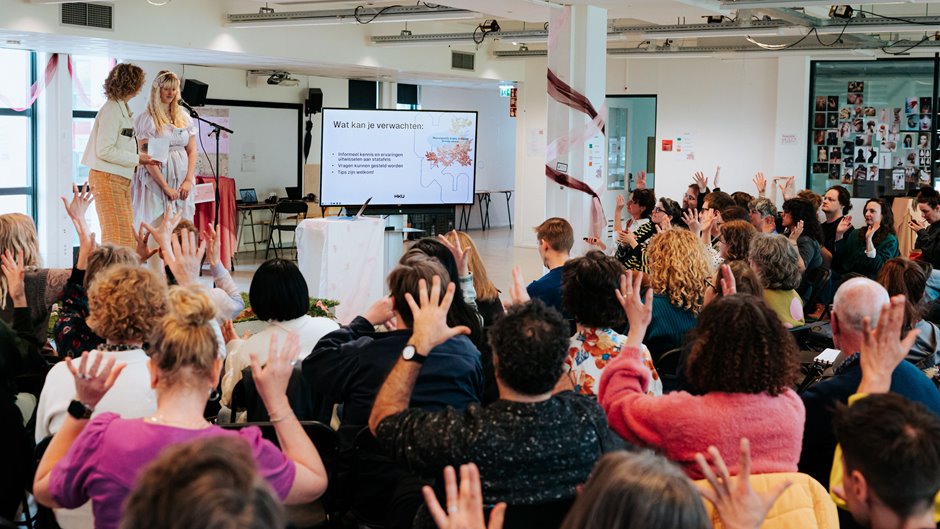
The special issue Towards neuro-inclusive arts education’ was presenteerd on 2 April, during World Autism Awareness Day, during a special conference about neuro-inclusive art education with students, professors and staff members of HKU and other (experience)experts. Photo: Lisanne Lentink.

More inclusive environment

Students who require additional support as a result of, for example, a disability or affliction, can often apply for individual facilities, such as extra time during assessments. Researchers of neuro-inclusive arts education take a critical view on this. This approach, based on the so-called ‘medical model’, which relies on diagnoses of mental health conditions, can lead to a sense of not belonging, of not being good enough, or of fundamentally not fitting within the higher education system.

Rather than approaching neuro-inclusion as an individual problem or ‘deficit’, the researchers advocate for the creation of a more inclusive environment in which as many students as possible can flourish.

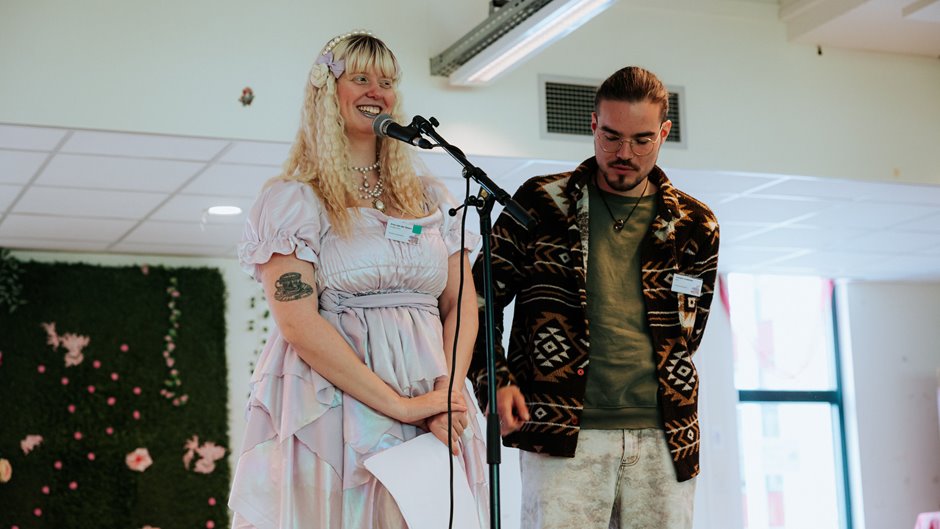
The event about neuro-inclusive arts education was hosted by the two student ambassadors from HKU’s autism student community. Photo: Lisanne Lentink.

Why in the arts education?

‘Arts education in particular includes a relatively large group of neurodivergent students,’ says Professor Fabiola Camuti, who co-curated the special issue together with HKU researcher Judith Leest. “Assumptions are sometimes made, unsolicited, about what a student might need based on a diagnosis. In addition, assignments in this field are often deliberately kept open-ended, so that students can develop their own creativity. For many autistic students, that can be a significant challenge. A neuro-inclusive learning environment can contribute to a more successful and positive educational experience for much more students.’

Ongoing discussion

The curators and contributors see the journal’s special issue as a conversation in motion, and as an invitation to educators, researchers, students and artists to continue learning together about what neuro-inclusive education can look like and how it might be shaped in practice. This requires listening even more closely to the lived experience of neurodivergent students.

'A neuro-inclusive learning environment can contribute to a more successful and positive educational experience for much more students’

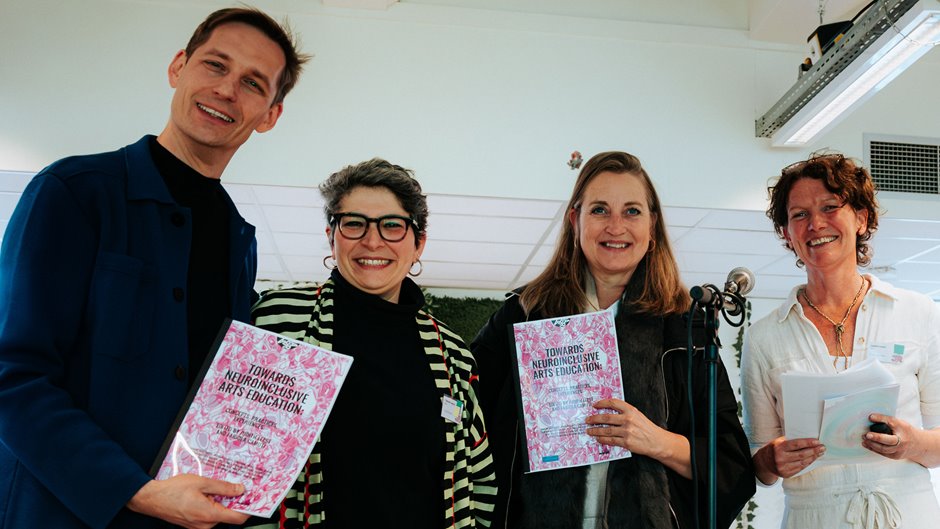
The curators of the special issue ‘Towards neuro-inclusive arts education’: professor Fabiola Camuti and HKU researcher Judith Leest, with the HKU Executive Board, Simon van Damme and Gaby Allard. Photo: Lisanne Lentink.

Lessons learned

This special issue forms part of the Neuroinclusive Arts Education research line within the professorship Critical Creative Pedagogies. Within this line, cooperation occurs with an HKU community for and by students with autism, an autism specialist, and a number of student ambassadors to explore what lessons can be learned about inclusive higher professional arts education.

One of the studies, for example, has led to a manifesto with tips for neuro-inclusive assessment (including: ‘Make clear in advance what we will be assessed on’ and ‘Allow input into the physical environment in which assessments take place’).

Another study identifies key factors for building a sustainable community of lived experience (such as: ‘Ensure the community has ownership, appoint an executive coordinator, and make it a space for unmasking’). One of the graduation research projects concludes with the following lesson: “Prior knowledge is not always required. Sometimes you can support someone simply by asking: ‘Is there anything you need?’.

Towards neuro-inclusive arts education is a special publication by APRIA, curated by professor Fabiola Camuti and HK researcher -Judith Leest, published in collaboration with HKU Press.