A robot with character
Interview with researcher Jorrit Thijn
Creative writers should play a much greater role in the development of robots, says Jorrit Thijn, PhD researcher at HKU and the Vrije Universiteit Amsterdam in the project Robotstories | Expanding Narratives. “My view of human beings is that identity emerges through the interactions you have with other people and with your environment. That’s the principle that I try to apply in the model for the robot.”
A robot with character
Cutting up the stuffed toys
Jorrit studied at HKU Theatre’s writing programme between 2004 and 2010. The seed of his wish to breathe life into something that is lifeless, was planted there, during the making of a theatre performance featuring a scene in which children destroy two soft toys. The scene was based on the Greek tragedy Medea, in which the title character kills her children. “When the scissors cut into the stuffed toys, the audience reacted incredibly shocked. That moment has always stayed with me.”'To my surprise, some people refused to give back the little block'
Growing fond of a metal block
His fascination eventually led him to HKU’s master’s programme Crossover Creativity, where Jorrit researched the animation of non-living entities. One of his experiments involved asking participants to carry around a small metal block for ten days. They were instructed to keep it warm and maintain a logbook during the process. “To my surprise, some people refused to give back the little block after those ten days, because they had grown fond of it.”Robots as story tellers
Going from stuffed toys to metal blocks to robots, was a process that took several years, but working with robots had long been a heartfelt wish for Jorrit. In 2016, he came across the Nijmegen-based literary organisation Wintertuin. “Their writers had started a project with Mike Ligthart, then a PhD candidate at Delft University of Technology, aimed at turning robots into storytellers for children. Exactly what I wanted to do as well!”Step towards PhD trajectory
From 2016 onwards, several shorter-term research projects were launched under the umbrella of Robotstories. Initially, these collaborations involved Vrije Universiteit Amsterdam and Wintertuin (the former TU Delft researcher had switched to another institution), and later HKU and ArtEZ joined as well. The collaboration proved so successful that Jorrit himself embarked on a doctoral trajectory last year. He now works in a tandem construction with fellow doctoral researcher Sander Goetzee from VU Amsterdam, under the banner of the latest follow-up project: Robotstories | Expanding Narratives.'We give the robot a history – a backstory'
A bit grumpy
““Until a few years ago, such a tool would have been highly scripted, structured on a so-called branching narrative,” Jorrit explains. “You begin with a storyline, and if person A says one thing, the robot responds in a particular way. If person B says something else, the robot gives a different response. It is a system of branching pathways, and each one had to be written out manually."
“However, now that the Large Language Models have become so huge, this is no longer necessary. We can structure the architecture differently by using this form of generative AI. For example, we can decide that our robot is a little grumpy in the morning and speaks in shorter sentences. Or make it more cheerful in the afternoon and more inclined to respond enthusiastically. We give the robot a background story. That story first needs to be translated into a model. That is what I will be working on. Sander will investigate how to connect this to our identity manager. The central research question is: how can you design more meaningful interactions between humans and robots?”
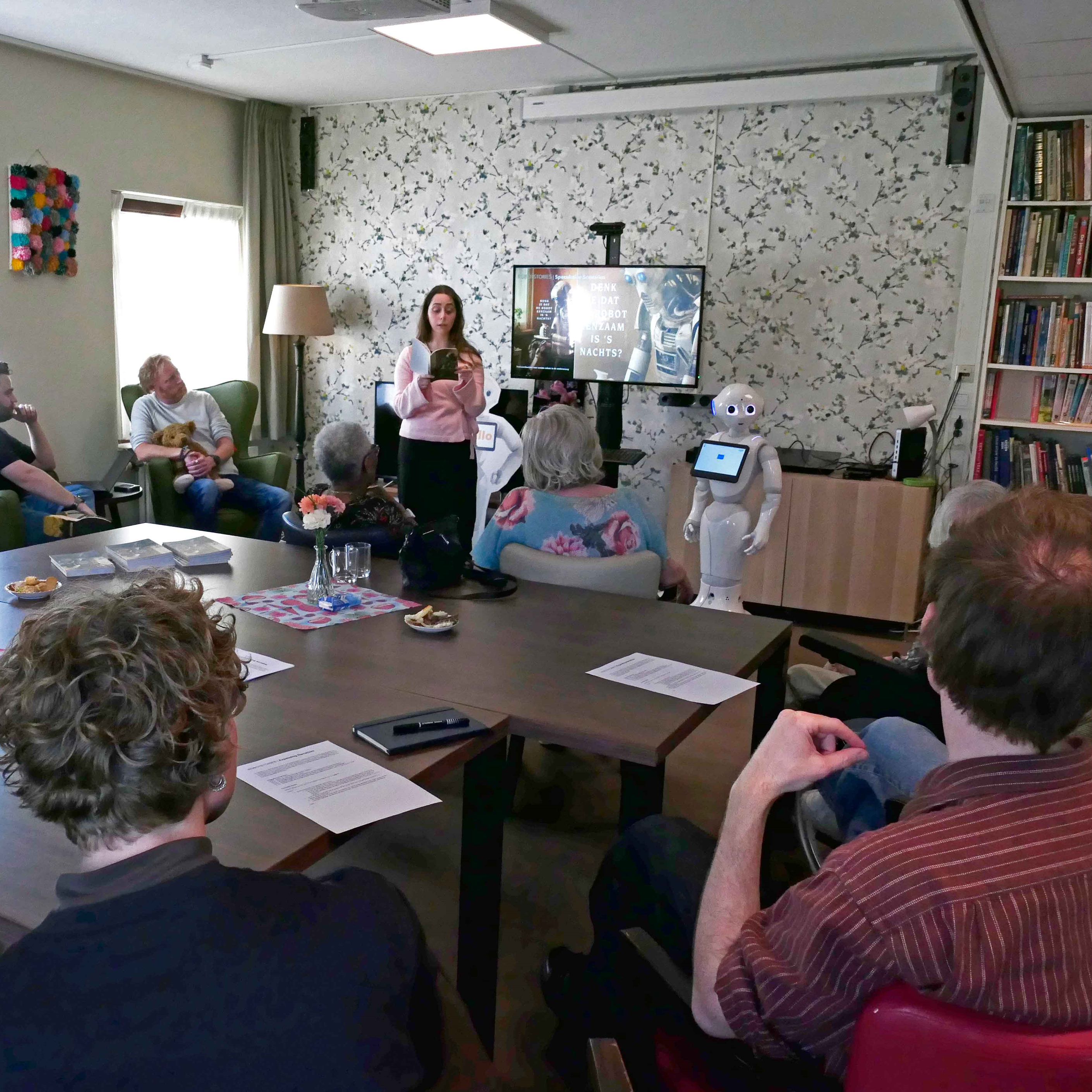 Lecturing researcher Hanan Faour, tenured at ArtEZ, does a short recital during the start of 'Robotstories | Expanding Narratives' in a care home in Utrecht.
Collaborating with creative writers
Creating such a backstory calls for a different way of writing stories for robots and AI. This is where creative writers come in. “Creative writers are exceptionally talented at imagining meaningful stories and connections,” Jorrit says. “They are able to create characters with highly complex identities from scratch. That expertise is urgently needed in the development of social robots.”To further explore this field, Hanan Faour, lecturing researcher at ArtEZ, is involved in the project. Hanan collaborates with three creative writers: Tine Tabak, alumnus of HKU’s Writing for Performance programme; Wietse Leenders, alumnus of ArtEZ Creative Writing; and writer Steff Geelen, from Wintertuin. Hanan will also work with students from ArtEZ’s Creative Writing programme.
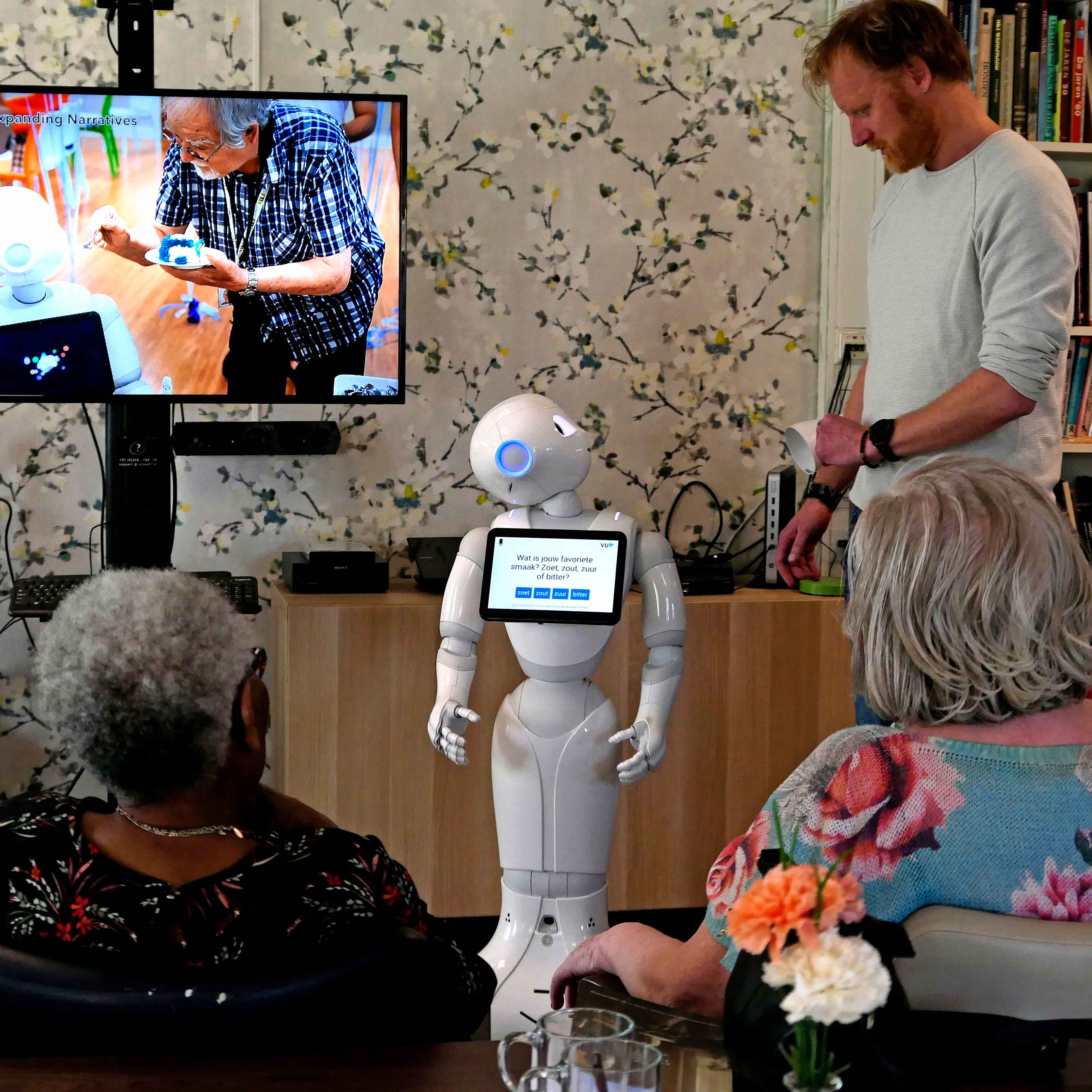 Jorrit Thijn talks with Pepper robot Memo and residents at the start of 'Robotstories | Expanding Narratives' in a care home in Utrecht.