Social value
Artists transforming former industrial factories and warehouses into vibrant places buzzing with activity: it has proven to be a successful formula for placemaking. And thus, local governments increasingly use creative hubs as instruments for making redevelopment projects and newly built neighbourhoods attractive to diverse audiences. A building full of studios, where artists generate creative energy and cross-pollination, can have a positive impact on its immediate surroundings and often stimulates wider cultural activity. This creates not only artistic, but also social and economic value across a broader area.
Artists losing out on the deal
At first glance, it seems like a win-win situation: artists get their own space to create work alongside like-minded practitioners, while neighbourhoods benefit from their presence. But what about the economic wellbeing of the artists? While local governments and property developers profit from creative bottom-up initiatives, there is often little in return for arts professionals. They are not paid for their contribution to community development, and after a few years, they often must make way for housing developments. “In the tension between local government and artists, the latter usually get the short end of the stick,” says Ruben de Boer.
Erosion of artistic practice
Over the next five years, De Boer will seek ways to improve this situation, through a PhD track founded by HKU in collaboration with Erasmus University Rotterdam. The working title: Making Creative Hubs Work: Towards a Sustainable Professional Practice for Arts Professionals. Supervised by Professor Erik Hitters of Erasmus University and co-supervisor Walter van Andel of HKU, he aims to explore whether the benefits generated by creative hubs can be distributed more equitably, so that tenants themselves also benefit more.
“Artists form the foundation of local creative hub policies, and much is expected from them. They are asked to revitalise old buildings, open their studios to the public, engage with local communities, and are often expected to help address wider societal challenges. The focus tends to be on what neighbourhoods and society need, rather than on what tenants themselves require. This brings the risk of hollowing out their artistic practice.”
Strengthening their market position
De Boer understands this reality from personal experience, having worked within the creative sector himself. He co-founded an art gallery in Utrecht and was active in improvisational theatre. And moreover, he worked for many years as a freelance filmmaker. Since 2016, he is also teaching at HKU’s Art and Economics academy, where students are trained to offer support and leadership within the cultural and creative sector. Here it’s mostly about the entrepreneurial aspects of the arts – an area where much improvement is still needed. “The percentage of artists earning below minimum wage is alarming. About half of them is living under welfare level. This is a systemic problem: the arts are still often regarded as a kind of left-wing hobby. I want to investigate whether, and how, creative hubs can help strengthen the labour market position of arts professionals.”
Insights for education
As a lecturer and initiator of the modules Design Thinking and Creative Start-up Lab, De Boer is continually engaged in making the artistic profession more future-proof. Several years ago, he developed ‘Het Werkspoorboekje’, (in Dutch) for the creative hub Werkspoorkwartier in Utrecht, with the aim of strengthening the position of creative professionals in the area. In retrospect, that project proved to be a precursor to the doctoral research he is now embarking on. In June, his project was approved, along with the awarding of the very first PhD voucher. This voucher was created specifically for research proposals that did not get NWO funding, but are considered so relevant to arts education that HKU chooses to fund them with their own means.
Making Creative Hubs Work aligns closely with HKU’s ambition to prepare students as effectively as possible for the labour market. De Boer will actively involve students in the research process, and the insights generated will feed directly and indirectly into the Art and Economics programme, as well as into the broader education across HKU.
Interviews and observations
Having graduated in anthropology from Utrecht University, De Boer intends to employ anthropological research methods, including semi-structured interviews combined with (photo-)elicitation techniques and participant observation. “In addition to source research, there will be lots of interviews and observation, in which I will use small interventions to explore what works and what not,” De Boer explains. He describes his approach as participatory research in the form of ethnographic fieldwork. He will become part of several creative hubs in Utrecht for a longer time, to get a clear view of what’s happening. Initially, his focus will be on the expectations and aspirations of tenants, but he also aims to understand the differing perspectives and interests of other stakeholders. His film camera will become an important research instrument. Because along with the required academic articles, he intends to produce a documentary and develop a design that sheds new light on creative hubs. “Combining the academic and the creative practices, is what I like.”
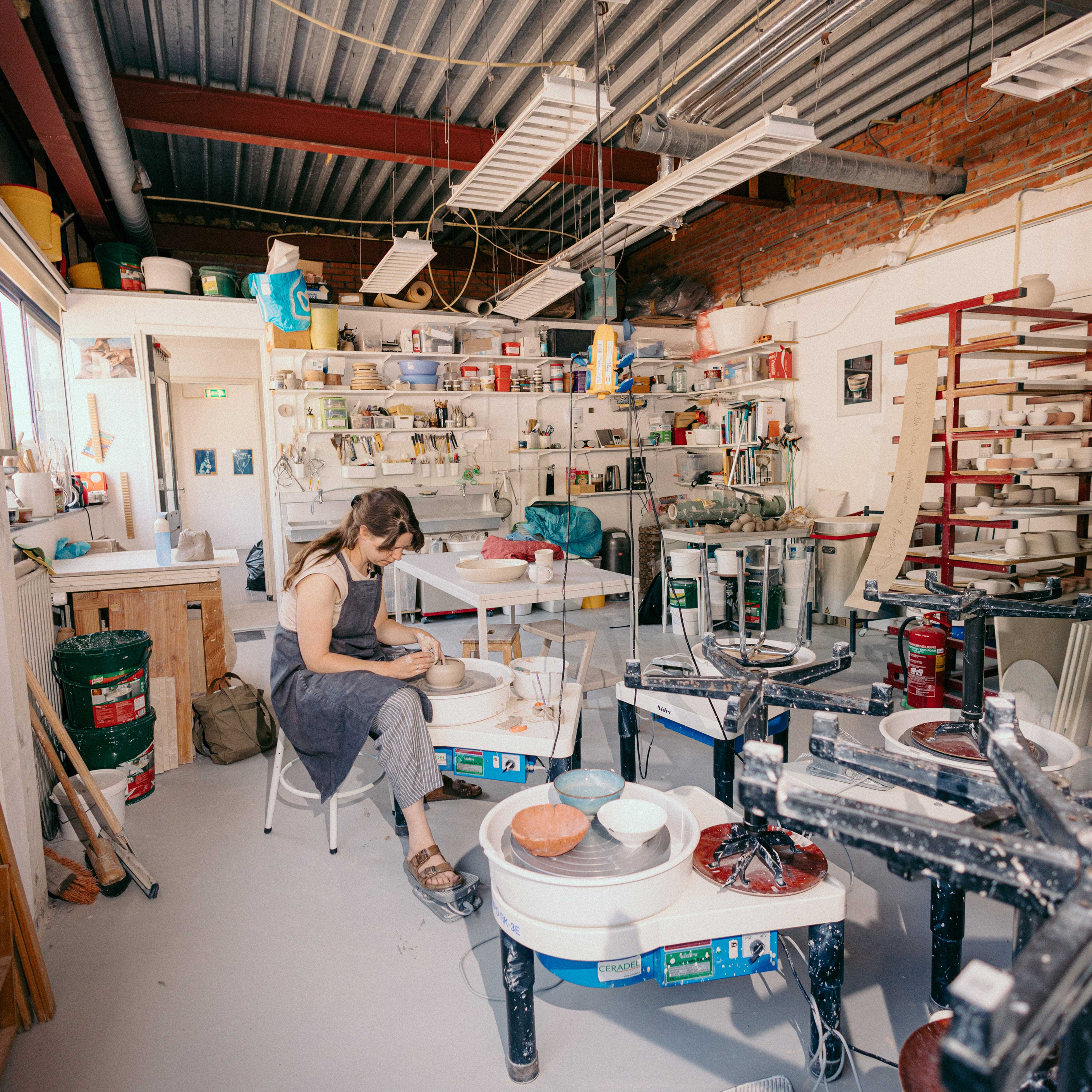 Image: artist in Vechtclub XL. Photo by Tanno Witkamp.