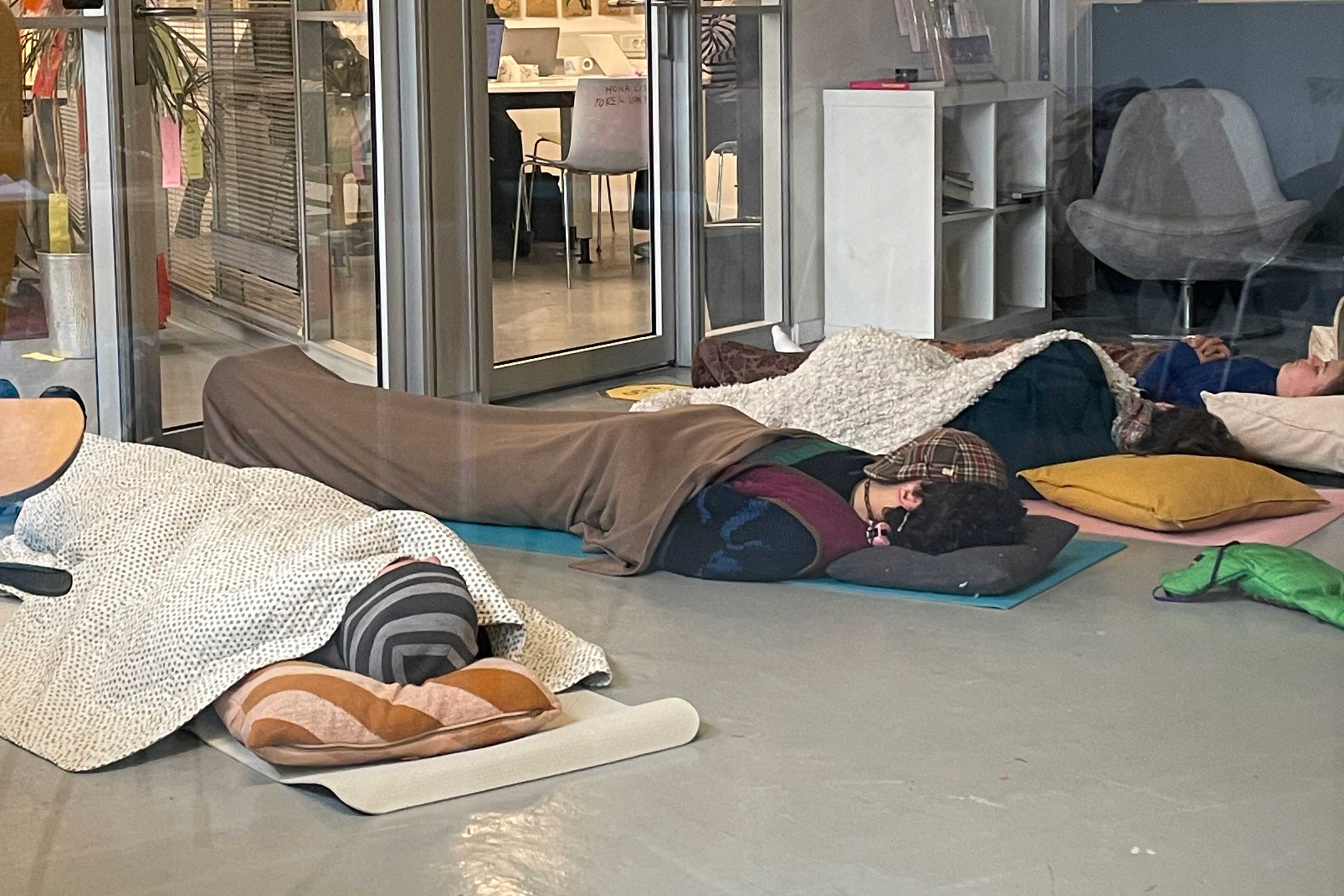
Balancing act
During the seminar, students explored the idea of doing nothing through a series of assignments. They were not given a prior definition and spent the first day considering what ‘doing nothing’ might actually mean. Jelle Ris, research associate at NIVOZ (research & development), wrote an article about it: an interview with Ellen Oosterwijk and Pavel van Houten and a report of the whole experiment.The balancing act was constantly palpable: how do you shape ‘doing nothing’ without turning it into something productive? Oosterwijk explains: ‘We deliberately chose not to frame doing nothing as a means to improve later actions. This was purely about doing nothing for its own sake, even though it seems impossible to avoid giving it some kind of meaning. Doing nothing as a means to stimulate creativity might be a possible starting point for a follow-up to the seminar.’
Regenerative education
A follow-up is both desired and planned. At HKU, regenerative education is steadily gaining ground. According to Ellen Oosterwijk, this is urgently needed in a society where our attention is constantly captured by capitalist influence. ‘It’s about forms of education that move beyond the beaten path. The HKU minor Arts and Ecology does this beautifully: the learning happens outside the classroom, with a strong focus on caring for the Earth — so thoroughly that it allows the earth to regenerate. And that same principle can be applied to how we care for one another and for ourselves.’Ellen Oosterwijk is researcher at the Professorship Critical Creative Pedagogies and teacher of professional didactics and pedagogy at HKU’s Fine Art in Design and Education programme.
Pavel van Houten is artist and educator, and founder of De Verveelclub (‘Boredom Club’) and partnered with Cultuurpad.